Overview
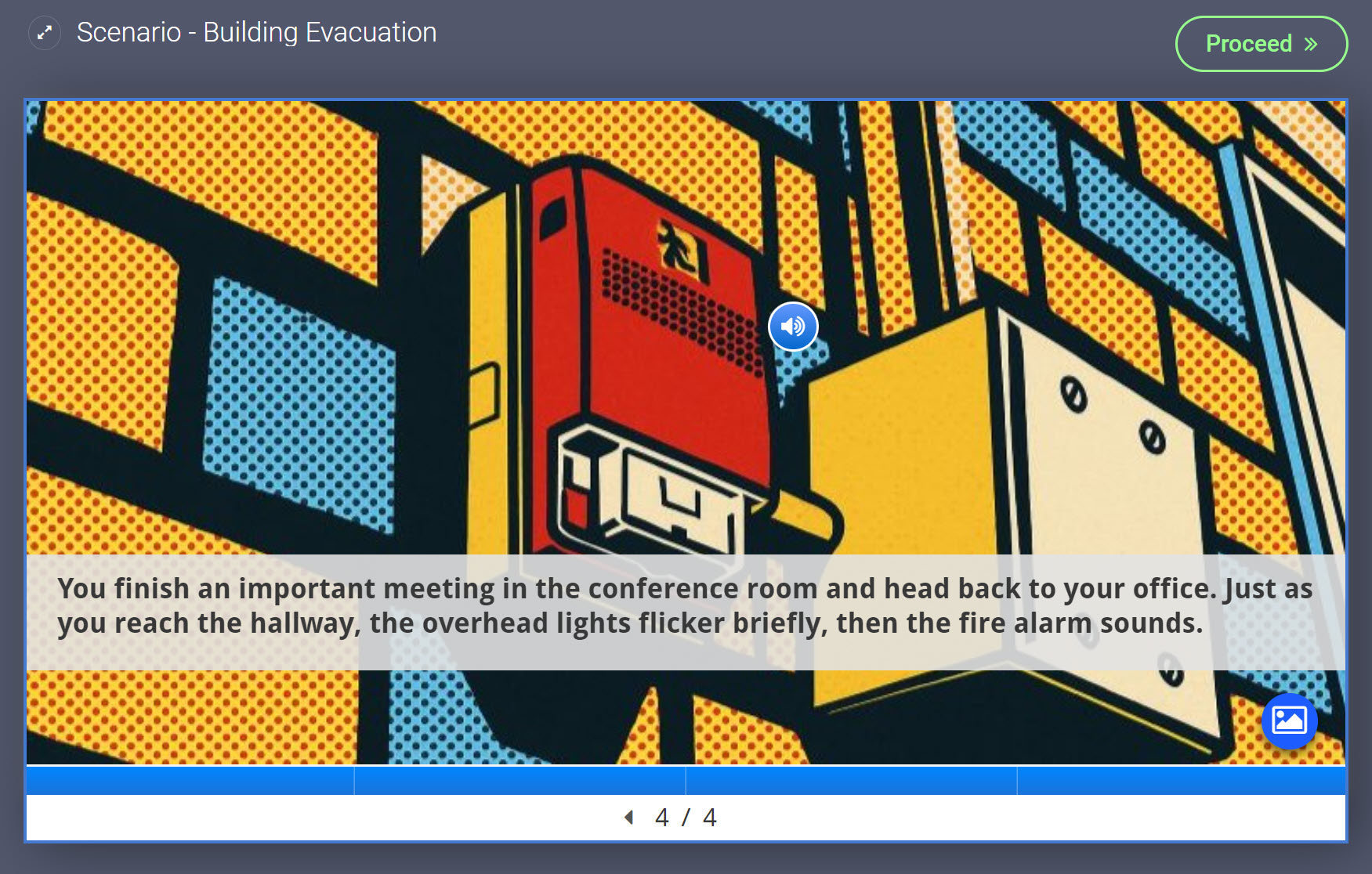
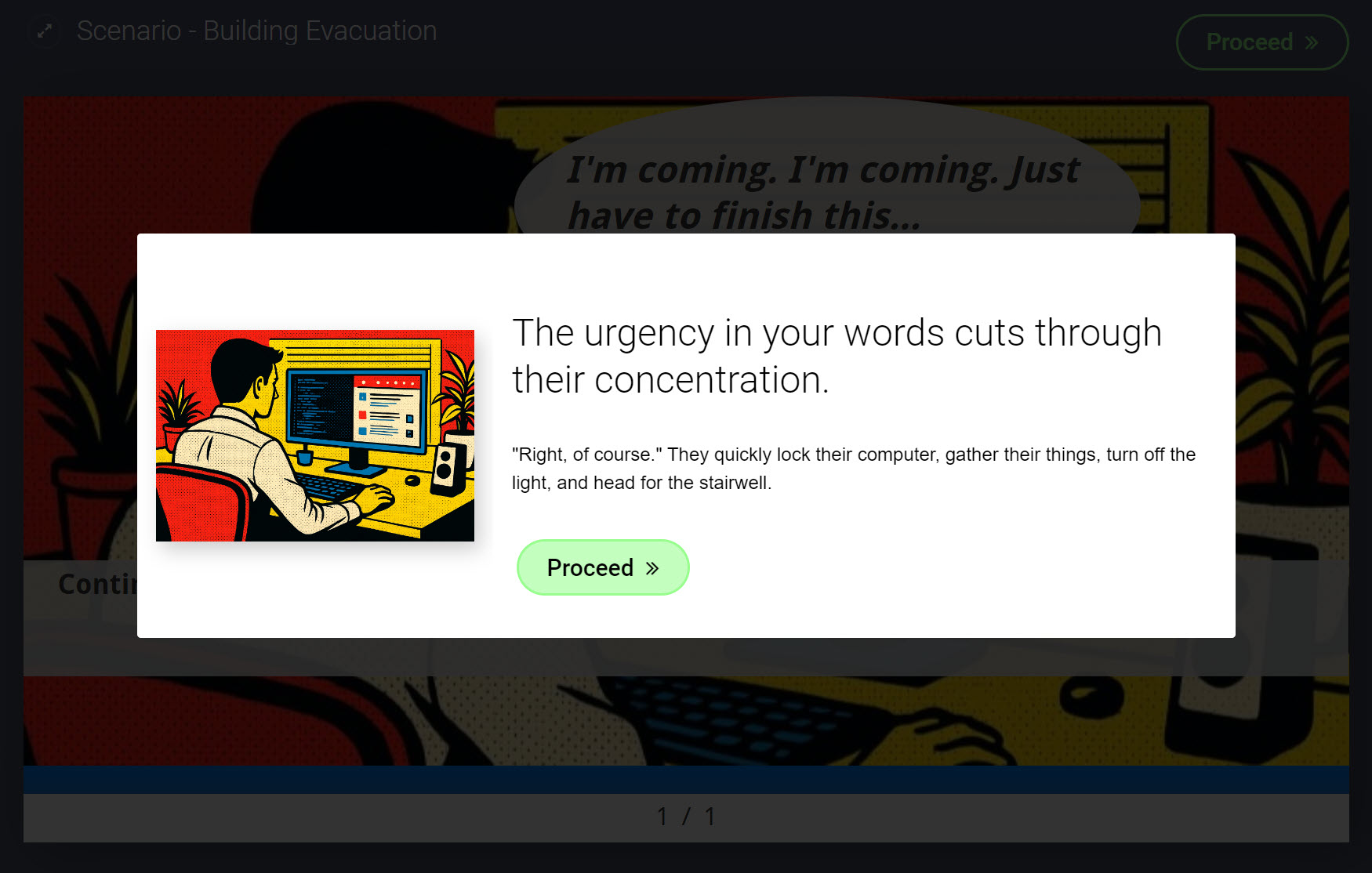
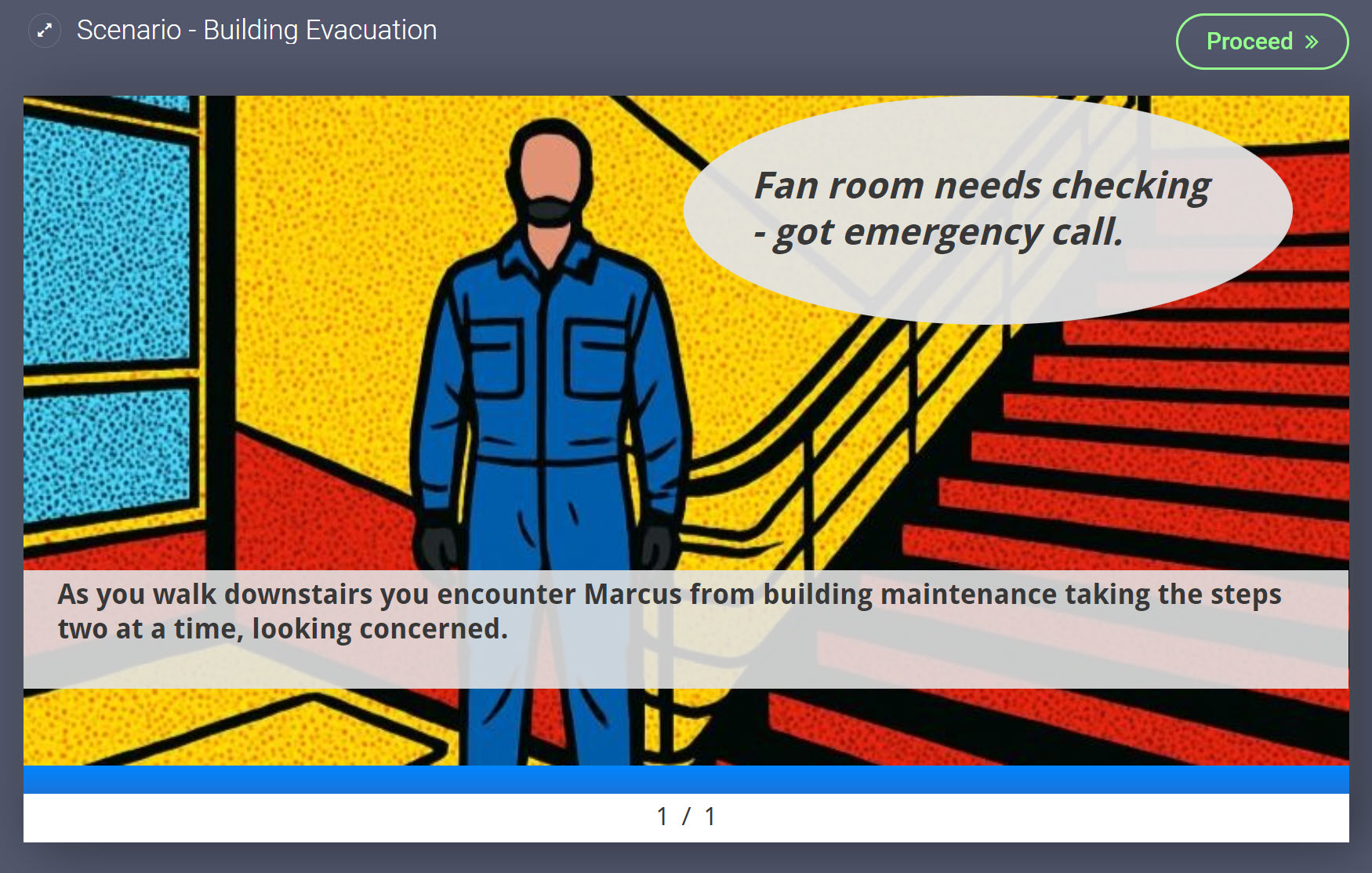
Health and Safety at a Canadian post-secondary institution requested an online floor warden training course. The course guides staff floor wardens through essential concepts for response and evacuations. It included didactic content, interactive learning aids, and quizzes. A key innovation in this course was a decision-based evacuation scenario where the staff member takes on their role as a floor warden, ensuring the building is evacuated safely and orderly. The course, specifically the Scenario, will help wardens fulfill their role effectively. This project brief will focus on the decision-based Scenario.
My Role
My goal was to create a meaningful scenario that focused on actual decisions an floor warden needs to make during a building evacuation rather than reciting facts and figures about the role. Facilitating regular discussions with the subject matter expert to tease out the optimal response and common mistakes for our participants placed in the situation. As an instructional designer, I fulfilled a variety of roles to ensure this project came to life:
- Instructional Design – Consulting with a manager of campus health and safety, I set pathways and decision points for a building evacuation scenario. Then, I prototyped an interactive version of the Scenario, validating the design with a group of safety professionals at the organization. Finally, I authored the completed interactive Scenario, including images and dialogues, and prepared it for deployment in the LMS.
- Copy Editing – Working with the decision outline developed during SME interviews, I authored expository content, dialogue, and feedback for the decision-based Scenario.
- Media/LMS Integration – The decision-based Scenario was packaged as SCORM-compliant content, providing reporting to the LMS (Brightspace).
- Graphic Design – drawing on photographs and video capture during evacuation drills, I created custom graphics to provide a consistent illustrated look and feel through the Scenario, and course more broadly.
Deliverables
- Course Materials: Four modules were developed. Beginning with an overview module, the course includes three topics covering essential aspects of response and evacuation. The course portion included tests-to-learn, concept cards, vocabulary cards, check-your-understanding activities, higher-order thinking activities for ILT, and a glossary. (.docx storyboards and .csv for LMS import)
- Decision-based Scenario including 22 decision points, multiple pathways and outcomes, and specific actionable feedback. (H5P, SCORM)
Problems to Solve
Health and Safety traditionally offered this training as in-person sessions led by an instructor. They expressed an interest in changing it to an online format to provide more flexibility and, hopefully, increased program uptake. In addition, they wanted an interactive online course, something more than static pages for participants to page through. Given that the participants are volunteering their time, the client also expressed that it was essential to keep the training brief and flexible to reduce attrition. Key problems to solve then were:
- The audience includes volunteers with limited time
- Moving from ILT to self-paced learning
- Changing from a didactic approach to something more experiential
Proposed Solution
As floor wardens, participants will be responsible for ensuring the safety of everyone in their assigned area during an evacuation. In this branching scenario challenge, they can test their decision-making skills based on their knowledge. They will be presented with various scenarios that could occur during an evacuation, and you will need to make quick, informed decisions to keep everyone safe.
Design Challenges
One particular challenge arose around what to do when participants made incorrect decisions in the Scenario. In different scenarios, a designer might send participants back to the beginning if the error is grave. However, given the potential length of this Scenario, sending participants too far back may lead to attrition. To address this challenge, working with the SME, I identified four key stages in the building evacuation scenario. When participants make minor errors, they may get to continue after receiving some feedback. For more significant mistakes, they are taken back into the Scenario to the beginning of the stage they were in. In addition to the feedback, participants understand the severity of their decisions in this format without being punished and creating a time-sink.
The toolset caused another design challenge that appeared. In one part of the scenario, participants make a report to their chief building officer using an interactive summary builder. However, there are different possible summaries to report depending on how an earlier part of the Scenario played out. In some eLearning tools, this can be accommodated easily. Using the particular toolset for this project, an initial path was developed, and then that pathway was duplicated and edited for the variances that decisions could make.
Lessons Learned
As the project progressed, a few lessons were reinforced that are important to consider for similar projects in the future. They include:
- Focus on creating meaningful scenarios. The Scenario in this project was designed to help participants apply what they’ve learned in a realistic situation.
- Collaborate with subject matter experts. Working closely with a subject matter expert (SME) can help ensure your content is accurate and relevant to the target audience. Regular communication and feedback from the SME can also help you refine your design and approach as you go.
- Use feedback to guide participants’ decision-making. Participants receive feedback on their decisions rather than being “punished” for incorrect choices.
- Address potential challenges early on. Early on, tease out potential challenges, such as attrition and tool limitations, and develop solutions to address them. Consider your project’s challenges and how you can proactively address them to ensure a smoother development process.