
The TU Delft Campus is full of interesting sculptures.
Working at the intersection of open research and open education
Erin McKiernan’s keynote provided a deeper dive on what open education could mean in a physiology classroom. There were not any mentions of textbooks, or wikipedia, but instead she focused on what teaching and learning looks like in physiology, labs. She described how she and her students used BackyardBrains, a company that builds and provides lab kit materials build on open tools to engage with lab experiments. BackyardBrains makes me think a bit about Paul Stacey’s book Made with Creative Commons (which I admit is still sitting on my shelf waiting to be read). You can see the work Erin and her students have done at their website, Electrophys.
Understanding the continuum open practice: a conceptual model for practitioner and institutional support of OEP
This presentation by Adrian Stagg, was maybe one of the most interesting sessions I attended at all of OE Global. As he went through his framework I think he articulated a number of things I felt in my gut about OEP for awhile now, and catching up with Adrian during one of the breaks we had a great conversation about the presentation and OEPs (that’s the real magic of attending these events). The presentation was mostly based on this paper as near as I can tell, or a continuation there of.
It began with a discussion about different scopes of systems we operate within: macro (national/international), exo (institutional), meso, and micro. Even right down to the distinction between “me” at home, vs “me” at work. This set the context for the work we do in open. It’s action within these contexts which we can use to make our work known, but the levels are something to pay attention to.
This notion Adrian put forth struck a chord with me. Having worked in schools, and a number of institutions I have seen first hand where the effort of individual students and teachers is what is making an impact in the classroom. I’ve also seen how cumbersome some of those bigger processes are. That’s not meant to cast mature processes as a villain – we get enough of that tired old trope from venture capital backed education ‘publications’ – but for example I as a teacher can have an impact with my students today. There is no need to wait necessarily on huge organizational frameworks and agreement between 10s of stakeholders, and to have standards set in place. Standards etc are useful at the macro and exo levels, but today, I can worry about the micro level. I’m sure we can all think of at least a few individuals who are making great strides in Open Ed and OEP because that’s who they are, not because of some top down policy.
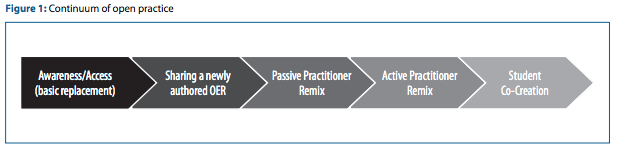
So then came the continuum or open practice. Notice something about it? I’ll wait. It’s horizontal. How many times do we see charts showing different degrees of “openness”, creative commons licenses, or open practices in a vertical orientation. The natural implication here is that one is not superior to the others, just different. I’m sure there are many in our community who believe then the goal is to get teachers/instructors/institutions onto this continuum and get them all the way to the right. I often here the refrain, especially from the open textbooks cost savings as gateway drug folks, that once instructors get ‘hooked’ on OER that they’ll change their pedagogical practice. I can’t say I’ve seen any one person move from one end of this continuum to the other, through all of these elements, and entirely. My hunch would be that there may be some movement between stages (which in hind sight, even though the figure is horizontal the use of the term “stage” also implies progression to the “top”) but that total transformation is rare. And you know what? I think that’s ok. Pedagogy is something that can be deeply personal, and so sure I can talk with you about your course and activities as an instructional designer and advocate for strategies to enhance student experience and learning. But does that mean I get to impose my views and values onto you, your course, and your students?
Collaboration: The Key Ingredient for a Sustainable Open Education Movement
Standing room only as @thatpsychprof and @acoolidge are about to rock our world talking about collaboration. #OEGlobal18 pic.twitter.com/elnDGsbo4F
— JR Dingwall (@JRDingwall) April 25, 2018
This was the first of a few rooms I attended at OEGlobal which was bursting at the seems, congrats Canada! Rajiv and Amanda did a stellar job, so I’ll just let their presentation speak for itself.
The Open Faculty Patchbook: A Community Quilt of Pedagogy
Shout out to Jenni and Terry for sharing their awesome work with this Patchbook idea. I know they’ve worked on a Faculty Patchbook as well as a Learner Patchbook. The overall ideas here were to provide a space for faculty and learners to share their real experiences. The target audience of the books is other faculty and learners who might end up in the same shoes as the authors. I believe the call for entries is always open, so if you’d like to contribute I’d encourage you to participate. I have a feeling that we will see more resources like these popping up. The Open Pedagogy Notebook is just one example of a logical extension of this approach.